Medical Waste Incinerator Solutions for Private Clinics in Ghana
Private clinics play an increasingly important role in Ghana’s healthcare system. In urban centers such as Accra and Kumasi, as well as in fast-growing secondary cities, private medical facilities handle a steady volume of infectious waste every day. Used needles, contaminated dressings, laboratory disposables, and expired medicines must be treated promptly to avoid infection risks for staff, patients, and surrounding communities.
For many clinic operators, the search for a medical waste incinerator for private clinics Ghana reflects a practical concern: how to manage regulated medical waste on site, with limited space, variable infrastructure, and strict attention to smoke, odor, and operational safety.
Waste Management Realities in Ghanaian Private Clinics
Private clinics in Ghana differ widely in size and service scope. Some operate as small outpatient centers, while others function as mid-scale facilities supporting maternity, diagnostic, and surgical services. Despite these differences, waste composition is often similar―infectious materials, sharps, and pharmaceutical residues form the bulk of daily output.
Incineration remains a commonly adopted treatment method because it allows immediate destruction of infectious waste without reliance on centralized disposal services, which may be inconsistent or distant. For private operators, on-site control is often seen as a way to reduce operational risk and administrative complexity.
Technical Configuration Commonly Used in Clinic Applications
Dual-Chamber Combustion Structure
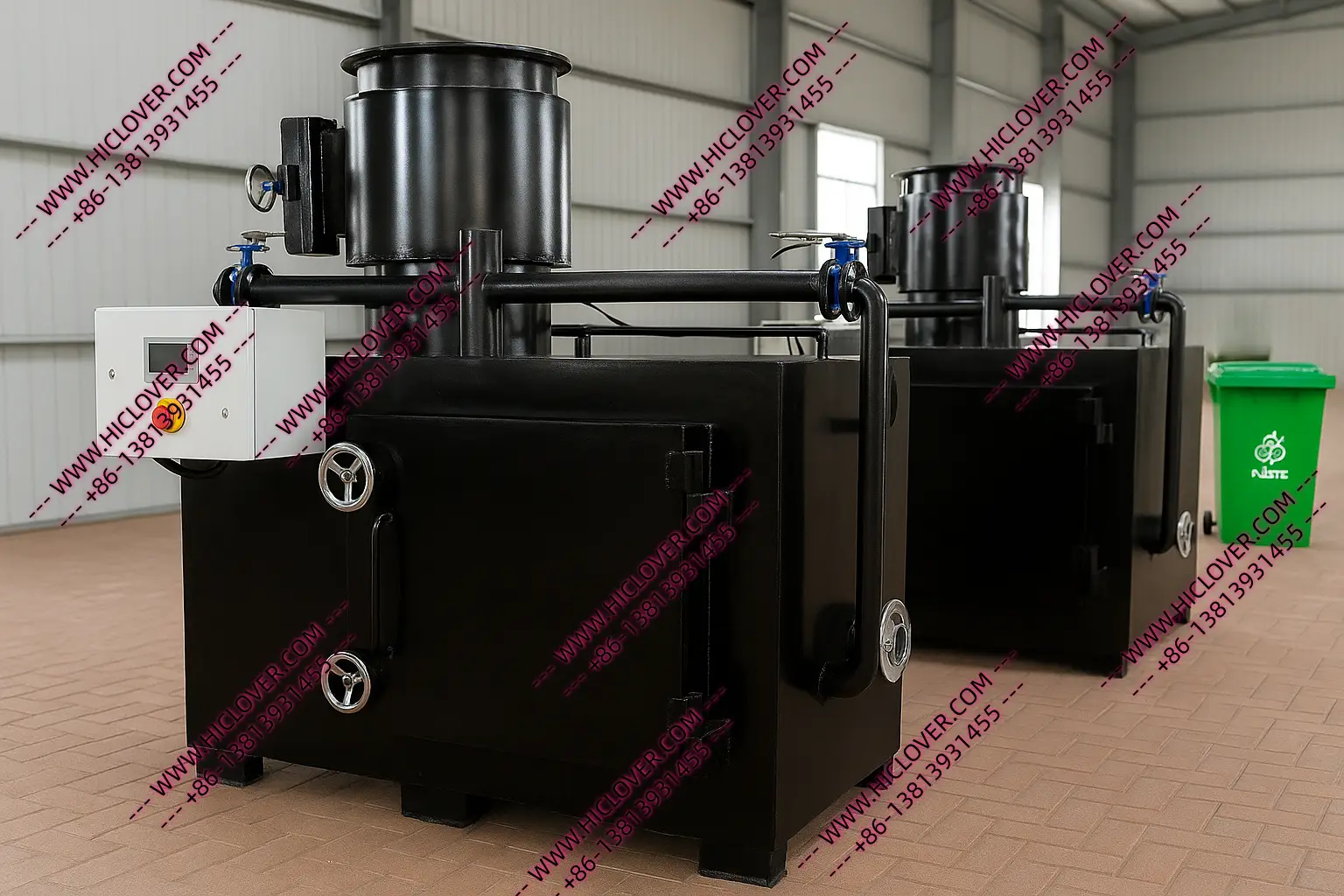
Medical waste incinerators supplied for private clinics typically follow a dual-chamber configuration. The primary chamber is used for direct combustion of waste at temperatures around 850 °C, supporting effective destruction of infectious materials and sharps.
A secondary chamber is installed downstream and operates at higher temperatures, often approaching 1100 °C. Its function is to re-burn flue gases released from the primary chamber. This secondary oxidation step reduces incomplete combustion products, helping to limit visible smoke and persistent odors―issues that private clinics are particularly sensitive to due to proximity to residential areas. This is a commonly adopted configuration for hospitals and clinics and is designed in line with common healthcare waste management practices.
Automation and Daily Operation in Small Facilities
Private clinics rarely have dedicated incinerator operators. As a result, automation plays a central role in equipment selection. PLC-controlled systems manage burner ignition, temperature holding, alarm functions, and safe shutdown sequences.
For clinic managers, this automation reduces reliance on individual operator experience and supports consistent daily operation. Clear status indicators and interlocks also improve operational safety, which is a key concern in facilities with limited technical staffing.
Diesel Operation Under Local Infrastructure Conditions
Power stability remains a practical consideration in many parts of Ghana. Even in urban areas, clinics often rely on backup generators to maintain essential medical services during outages. Diesel-fired incinerators align well with this environment, as combustion stability does not depend on continuous grid power.
Electrical consumption is largely limited to controls and auxiliary components, making it feasible for clinics to operate incinerators alongside existing generator systems. This balance between fuel-based combustion and low electrical demand is one reason diesel configurations are widely selected by private healthcare providers.
Emission Control Options for Clinic Environments
Private clinics often face closer scrutiny from neighbors and local authorities regarding smoke and odor. Incinerator systems therefore offer configurable flue gas treatment options.
Dry gas treatment units are commonly selected as baseline solutions due to simpler operation and maintenance. For clinics seeking enhanced emission control, wet scrubbing systems may be added, integrating quenching and washing stages to further reduce visible emissions. These options are typically presented as modular choices, allowing clinic operators to align system complexity with available space, budget, and maintenance capacity.
Matching System Size to Clinic Scale
A medical waste incinerator for private clinics in Ghana is usually selected based on realistic daily waste volumes rather than maximum theoretical capacity. Small clinics may operate compact, batch-fed units, while larger private hospitals may require systems capable of extended daily operation.
Containerized layouts are often favored where space is limited or where clinics wish to minimize civil works. This flexibility allows private healthcare providers to adopt incineration without major disruption to existing facilities.
HICLOVER as a Manufacturing Partner
HICLOVER operates as a manufacturing factory supplying standardized medical waste incinerator systems for export markets, including configurations suited to private clinics. Its equipment is based on repeatable designs supported by technical documentation, operation manuals, and remote technical coordination.
General system information and configuration options can be reviewed through the official website:
https://www.hiclover.com/
This manufacturer-focused approach supports private clinics, engineering contractors, and NGO programs that evaluate incineration solutions through English-language technical searches.
Practical Perspective for Private Clinic Decision-Makers
For private clinics in Ghana, selecting a medical waste incinerator is less about scale and more about operational fit. Combustion stability, automation level, emission visibility, and ease of daily use often outweigh purely theoretical performance metrics.
In a healthcare environment shaped by rapid urban growth, infrastructure variability, and increasing attention to infection control, well-configured incineration systems remain a practical option for private clinics seeking reliable on-site medical waste management.